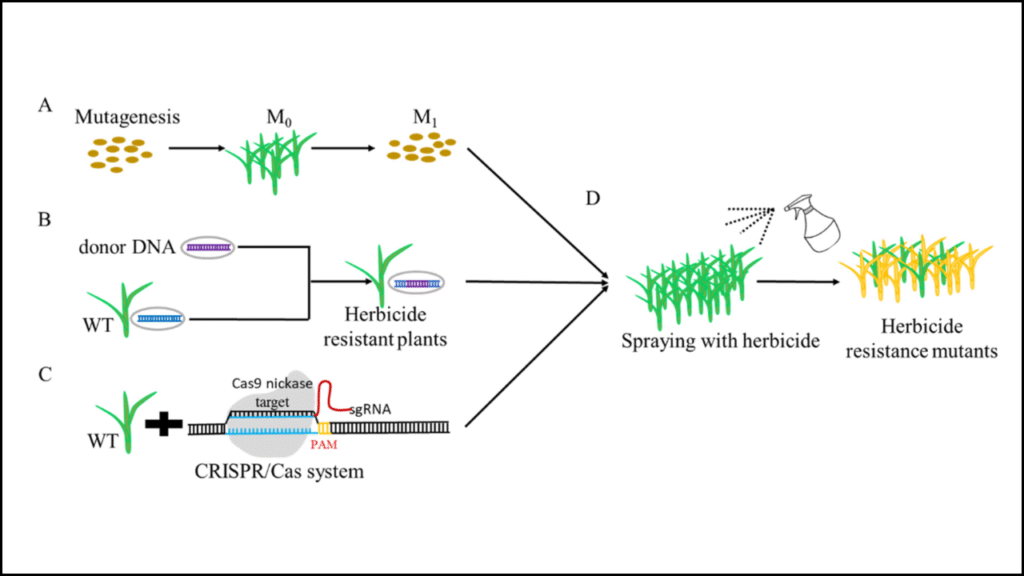
Agricultural innovation depends on the development of crops that can withstand environmental stress and chemical exposure. Herbicide-tolerant crops have become a critical part of sustainable weed management systems. The emergence of CRISPR (Clustered Regularly Interspaced Short Palindromic Repeats) technology has revolutionized plant breeding by offering a precise, efficient, and cost-effective method for genetic improvement. Through targeted genome editing, scientists can modify or disable specific genes that confer herbicide sensitivity, thereby creating crop varieties capable of surviving herbicide application without damaging yield or quality.
Table of Contents
Concept Of CRISPR Technology
CRISPR-Cas9 is a genome-editing tool that allows scientists to modify DNA sequences with high precision.
The system uses a Cas9 enzyme guided by a small RNA molecule to target specific genes for editing.
The technology can knock out, replace, or insert genes responsible for herbicide sensitivity.
It provides a faster and more accurate alternative to traditional breeding and mutation methods.
Objectives Of CRISPR-Based Herbicide Tolerance
Improve tolerance against commonly used herbicides such as glyphosate, glufosinate, and 2,4-D.
Reduce the dependency on manual weeding and enhance labor efficiency.
Minimize crop losses caused by accidental herbicide drift.
Enable integrated weed management with minimal environmental impact.
Challenges In Developing CRISPR-Based Herbicide Tolerance
Challenge
Explanation
Possible Solution
Off-Target Mutations
Unintended gene edits can cause undesired traits.
Use advanced Cas variants with higher specificity.
Regulatory Barriers
Differing GMO regulations affect global adoption.
Develop clear policies for non-transgenic gene edits.
Public Perception
Lack of awareness leads to skepticism about gene-edited crops.
Conduct transparent communication and awareness programs.
Weed Resistance Evolution
Overuse of herbicide-tolerant crops can lead to resistant weeds.
Rotate herbicides and adopt integrated weed management.
Technical Limitations
Some crops show low transformation efficiency.
Optimize delivery methods such as RNP complexes.
Integration Of CRISPR With Other Breeding Tools
Marker-Assisted Selection (MAS): Helps identify and track edited genes in breeding populations.
Genomic Selection: Predicts best-performing lines with herbicide tolerance traits.
RNA-Guided Base Editing: Allows single-nucleotide substitutions without double-strand breaks.
Multiplex Editing: Enables simultaneous modification of multiple genes for broad resistance.
Synthetic Biology: Combines CRISPR with metabolic engineering to enhance detoxification pathways.
Future Prospects Of CRISPR In Weed Management
Development of multi-herbicide-tolerant crops to manage diverse weed populations.
Creation of customized gene-editing platforms for smallholder farmers.
Use of CRISPR-Cas12 and Cas13 systems for RNA-level regulation of herbicide response genes.
Establishment of bioinformatics pipelines for precision target prediction.
Integration with sustainable agroecological systems to reduce environmental footprints.
Best Practices For Responsible Implementation
Conduct thorough risk assessments before field release.
Ensure compliance with national biosafety standards.
Promote crop rotation to prevent weed resistance buildup.
Train farmers in herbicide management and gene-edited crop handling.
Encourage public-private partnerships for technology dissemination.
Summing Up
CRISPR technology has opened a new era in crop science, offering remarkable opportunities for developing herbicide-tolerant crops. Its precision, speed, and adaptability make it an ideal tool for addressing modern agricultural challenges. By editing specific genes associated with herbicide sensitivity, researchers can create resilient varieties that enhance productivity while minimizing environmental harm. Responsible application, regulatory clarity, and farmer awareness will be essential to ensure that CRISPR-based herbicide-tolerant crops contribute effectively to sustainable agricultural systems and global food security.
She is a creative and dedicated content writer who loves turning ideas into clear and engaging stories. She writes blog posts and articles that connect with readers. She ensures every piece of content is well-structured and easy to understand. Her writing helps our brand share useful information and build strong relationships with our audience.