Hybrid vigor, also known as heterosis, plays a significant role in enhancing crop productivity and adaptability. Sorghum (Sorghum bicolor), a vital cereal crop cultivated in tropical and semi-arid regions, benefits immensely from hybrid breeding programs. Hybrid vigor in sorghum results in improved yield, disease resistance, stress tolerance, and biomass production. Understanding the genetic implications behind this phenomenon helps breeders design more efficient hybridization strategies for sustainable agricultural advancement.
Table of Contents
Concept Of Hybrid Vigor (Heterosis)
Hybrid vigor (heterosis) refers to the superior performance of hybrid offspring compared to their parents.
The trait is commonly observed in yield, growth rate, and resistance to environmental stresses.
In sorghum, hybrid vigor is exploited to enhance grain yield, plant height, and adaptability across diverse agro-climatic conditions.
The phenomenon is primarily governed by genetic interactions such as dominance, overdominance, and epistasis.
Objectives Of Studying Hybrid Vigor In Sorghum
Understand the genetic mechanisms influencing heterosis.
Improve hybrid breeding efficiency.
Develop high-yielding and stress-tolerant sorghum hybrids.
Utilize molecular markers for hybrid prediction and selection.
Strengthen food and feed security in arid regions.
Genetic Basis Of Hybrid Vigor
Genetic Mechanism
Description
Example/Effect In Sorghum
Dominance Hypothesis
Superior alleles from one parent mask the deleterious ones from another.
Improved yield and vigor due to dominance of favorable alleles.
Overdominance Hypothesis
Heterozygous combinations of alleles show superior performance over either homozygote.
Enhanced grain weight and drought tolerance.
Epistasis
Interactions between genes at different loci enhance hybrid performance.
Synergistic gene actions improve biomass and yield stability.
Additive Effects
Combined influence of alleles from both parents.
Consistent improvement in plant height and seed quality.
Role Of Cytoplasmic Male Sterility (CMS) In Sorghum Hybridization
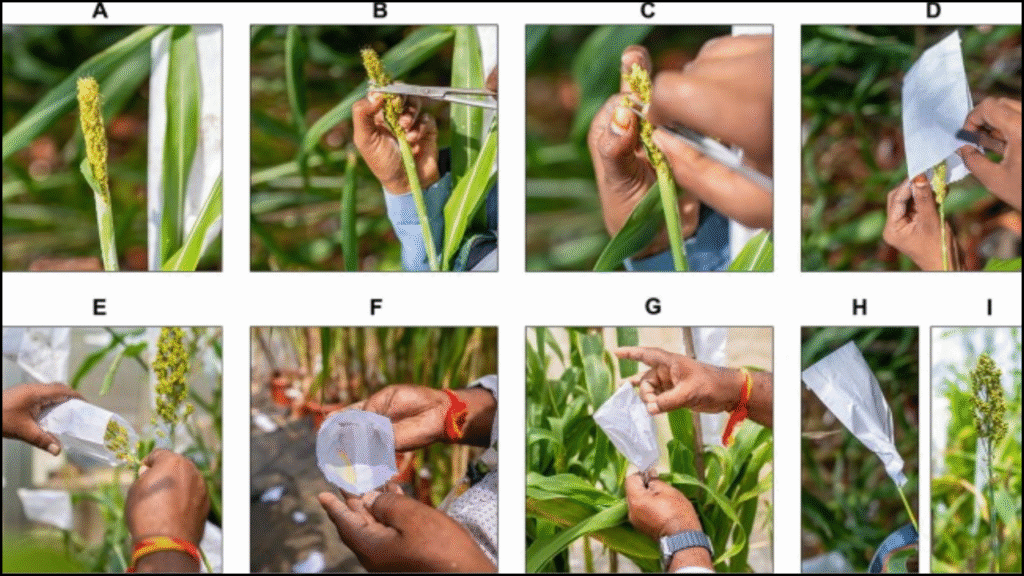
CMS systems facilitate hybrid seed production by preventing self-pollination.
The A-line (male sterile), B-line (maintainer), and R-line (restorer) are used in hybrid development.
CMS-based hybrids have contributed significantly to sorghum yield improvement.
The genetic interaction between nuclear and cytoplasmic genes influences hybrid vigor expression.
Key Genetic Markers Associated With Hybrid Vigor In Sorghum
Marker Type
Application
Benefit
SSR (Simple Sequence Repeats)
Detects polymorphism between parental lines.
Helps in selecting diverse and complementary parents.
SNP (Single Nucleotide Polymorphisms)
Provides high-resolution genetic mapping.
Enhances accuracy in predicting heterotic potential.
QTL (Quantitative Trait Loci)
Identifies genomic regions linked to yield traits.
Assists in marker-assisted hybrid breeding.
Genomic Selection Models
Predicts performance using genome-wide data.
Reduces breeding cycles and cost.
Traits Influenced By Hybrid Vigor In Sorghum
Trait
Hybrid Advantage
Genetic Implication
Grain Yield
20–50% increase compared to inbred lines.
Additive and dominance gene effects.
Plant Height
Taller and more robust plants.
Enhanced cell elongation and hormonal balance.
Tillering Capacity
Improved tiller number per plant.
Activation of growth-regulating genes.
Biomass Production
Greater vegetative growth and leaf area.
Overdominance and epistatic interactions.
Stress Tolerance
Better drought and heat resistance.
Expression of heterozygous stress-responsive alleles.
Nutrient Use Efficiency
Enhanced nitrogen and phosphorus utilization.
Improved root development and metabolism.
Molecular Insights Into Heterosis Expression
Transcriptomic Studies: Show higher expression of genes related to photosynthesis, metabolism, and growth in hybrids.
Proteomic Analysis: Reveals increased enzyme activity for energy metabolism and protein synthesis.
Epigenetic Regulation: DNA methylation and histone modification contribute to gene expression variation in hybrids.
Non-Coding RNAs: Small RNAs play regulatory roles in controlling hybrid vigor-associated genes.
Environmental Influence On Hybrid Vigor
Hybrid performance varies across soil types, temperature, and moisture availability.
Environmental interaction with genotype (G×E) affects the expression of yield-related traits.
Stable hybrids are those that maintain superior performance under both optimal and stress conditions.
Advantages Of Hybrid Vigor In Sorghum Production
Higher Yield Potential: Enhanced productivity even under marginal conditions.
Economic Viability: Increased profitability for farmers through higher returns.
Challenges In Utilizing Hybrid Vigor
Challenge
Impact
Possible Solution
Limited Genetic Diversity
Narrow parental base reduces heterosis potential.
Introduce wild and exotic germplasm into breeding pools.
High Seed Cost
Hybrid seed production is expensive.
Develop cost-efficient CMS systems and seed multiplication methods.
Yield Instability
Some hybrids perform inconsistently under stress.
Employ genomic selection and environmental adaptability testing.
Complex Genetic Interactions
Difficult to predict hybrid performance.
Use molecular markers and predictive models.
Farmer Accessibility
Lack of awareness limits hybrid adoption.
Promote extension programs and hybrid demonstrations.
Recent Advances In Sorghum Hybrid Breeding
Application of genomic selection for faster prediction of hybrid performance.
Use of CRISPR-Cas9 for targeted improvement of yield and stress tolerance genes.
Integration of high-throughput phenotyping tools to evaluate hybrid vigor precisely.
Transcriptomic analysis for identifying heterosis-associated genes.
Development of multi-parental breeding populations to enhance genetic variability.
Genetic Implications For Future Breeding Programs
Maintenance of broad genetic diversity is essential to sustain hybrid vigor.
Incorporation of molecular-assisted selection can refine parental choice.
Epigenetic modifications should be explored as potential drivers of heterosis.
Genomic prediction models can help in pre-selecting high-performing hybrid combinations.
Collaboration between geneticists and breeders can accelerate hybrid improvement programs.
Best Practices For Exploiting Hybrid Vigor
Select genetically diverse parental lines based on molecular distance.
Use CMS systems for efficient hybrid seed production.
Evaluate hybrids across multiple environments before release.
Incorporate marker-assisted selection to track heterosis-related genes.
Maintain hybrid seed purity to ensure performance consistency.
Final Thoughts
Hybrid vigor in sorghum stands as a cornerstone of modern crop improvement. Its genetic basis, rooted in complex interactions among dominance, overdominance, and epistasis, provides valuable insights for breeding programs. Molecular and genomic tools have strengthened the ability to predict and exploit heterosis effectively. By combining traditional breeding wisdom with advanced genetic technologies, sorghum hybrids can continue to deliver higher productivity, stress resilience, and nutritional quality, ensuring agricultural sustainability and food security in challenging environments.
She is a creative and dedicated content writer who loves turning ideas into clear and engaging stories. She writes blog posts and articles that connect with readers. She ensures every piece of content is well-structured and easy to understand. Her writing helps our brand share useful information and build strong relationships with our audience.