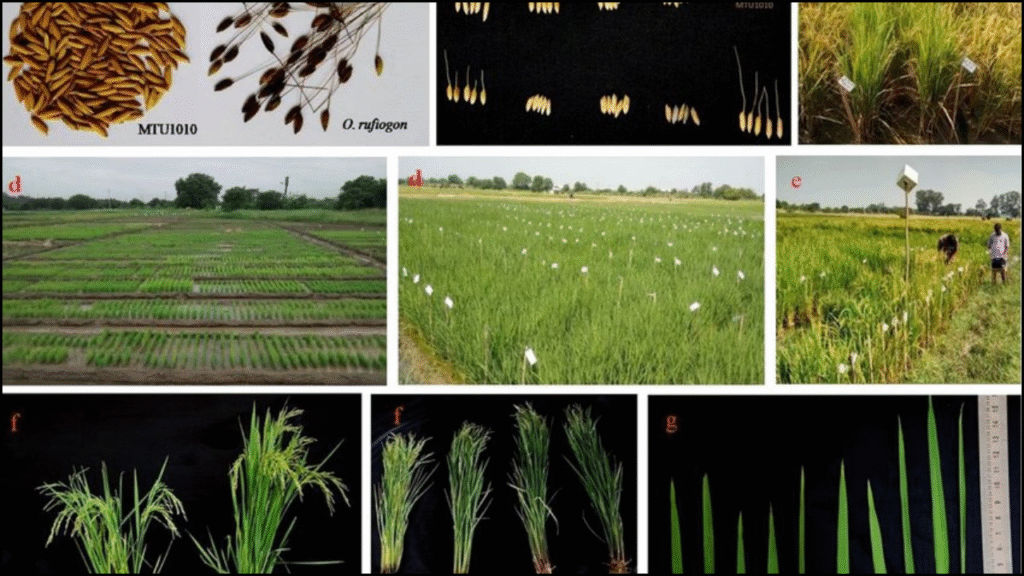
Rice (Oryza sativa L.) stands as one of the most important staple crops worldwide, feeding more than half of the global population. Improving rice yield is a primary goal for agricultural scientists due to increasing food demand and limited arable land. Understanding the genetic basis of yield-related traits provides the foundation for effective breeding strategies. Genetic mapping allows researchers to identify quantitative trait loci (QTLs) and genes associated with yield components such as panicle length, grain weight, number of tillers, and seed setting rate. This information accelerates the development of high-yielding rice varieties through marker-assisted selection and genomic breeding approaches.
Table of Contents
Importance Of Genetic Mapping In Rice Breeding
Provides detailed insight into gene locations controlling yield and quality traits.
Enables marker-assisted selection (MAS) for rapid breeding of superior varieties.
Facilitates identification of quantitative trait loci (QTLs) governing complex traits.
Helps in the transfer of desirable genes from wild relatives to cultivated species.
Supports the development of climate-resilient and high-yielding cultivars suitable for global food security.
Major Yield-Related Traits In Rice
Trait
Description
Influence On Yield
Panicle Length
Length of the main flowering branch bearing grains.
Determines grain-bearing potential.
Number of Tillers
Count of productive shoots per plant.
Directly affects total grain yield.
Grain Weight
Weight of 1,000 grains or individual kernel size.
Major determinant of yield and market value.
Grain Number per Panicle
Total grains per inflorescence.
Contributes to potential yield capacity.
Seed Setting Rate
Ratio of filled grains to total florets.
Reflects reproductive success and yield efficiency.
Plant Height
Influences lodging resistance and biomass distribution.
Balances yield and mechanical stability.
Harvest Index
Ratio of grain yield to total biomass.
Measures efficiency of assimilate partitioning.
Techniques Used In Genetic Mapping
Mapping Technique
Principle
Application In Rice
Linkage Mapping
Uses segregating populations to find an association between markers and traits.
Detects QTLs for yield and related traits.
Association Mapping (GWAS)
Identifies natural genetic variation using diverse germplasm.
Locates SNPs associated with grain quality and yield.
Fine Mapping
Narrows down genomic regions of major QTLs.
Identifies candidate genes controlling yield.
Comparative Genomics
Compares genomes of rice subspecies and relatives.
Discovers conserved yield-regulating genes.
Genomic Selection
Uses genome-wide markers to predict performance.
Enhances breeding efficiency for complex traits.
Populations Used For Genetic Mapping
F2 Populations: Derived from crossing two parent lines, useful for initial QTL mapping.
Recombinant Inbred Lines (RILs): Developed through repeated selfing, providing stable genetic variation.
Backcross Inbred Lines (BILs): Used to introgress specific QTLs into elite backgrounds.
Double Haploid (DH) Populations: Enable rapid development of homozygous lines for precise mapping.
Natural Populations: Utilized in association studies for high-resolution mapping.
Major QTLs Identified For Yield-Related Traits In Rice
Expression of yield-related genes is highly influenced by environmental factors such as temperature, water availability, and nutrient levels.
Genotype-environment interactions often complicate QTL detection.
Multi-environment trials are necessary to ensure stability of QTL effects across ecosystems.
Genes like Ghd7 and Hd1 show varying expression under different photoperiods, affecting flowering and yield.
Use Of Wild Relatives In Genetic Improvement
Wild species such as Oryza rufipogon and Oryza nivara provide valuable alleles for yield enhancement.
Introgression of QTLs from wild relatives broadens the genetic base of cultivated rice.
Wild alleles often contribute to drought tolerance, pest resistance, and grain productivity.
Hybridization between wild and cultivated genotypes has produced superior recombinant lines for mapping studies.
Applications Of Genetic Mapping In Modern Breeding
Application
Purpose
Outcome
Identification Of QTL Hotspots
Locates regions controlling multiple yield traits.
Enables targeted breeding.
Gene Pyramiding
Combines multiple yield-enhancing genes.
Increases productivity and stability.
Development Of Introgression Lines
Incorporates useful genes from diverse backgrounds.
Improves stress adaptation.
Molecular Characterization Of Elite Lines
Assesses genetic purity and potential.
Enhances cultivar development.
Functional Genomics Studies
Links genes to biological pathways.
Advances in the understanding of yield regulation.
Challenges In Genetic Mapping Of Yield Traits
Challenge
Impact
Possible Solution
Complex Genetic Architecture
Yield traits are controlled by many minor genes.
Use high-density molecular markers and GWAS.
Environmental Variability
Reduces accuracy of QTL detection.
Conduct multi-location and multi-year trials.
Limited Genetic Diversity
Narrow genetic base in cultivated rice.
Utilize wild relatives and landraces.
Epistatic Interactions
Gene–gene interactions complicate mapping.
Apply systems biology and statistical genomics.
Cost Of Genomic Analysis
High sequencing and data processing expenses.
Use cost-effective genotyping platforms.
Future Prospects Of Rice Genetic Mapping
Implementation of whole-genome sequencing for comprehensive QTL discovery.
Application of CRISPR-Cas9 gene editing to modify yield-enhancing loci.
Integration of multi-omics data (genomics, transcriptomics, metabolomics) for trait prediction.
Use of artificial intelligence (AI) in analyzing large genomic datasets.
Development of climate-smart rice varieties resilient to stress while maintaining yield potential.
End Notes
Genetic mapping of yield-related traits in rice serves as a cornerstone of modern crop improvement programs. By identifying QTLs and genes governing productivity, breeders can efficiently develop high-yielding and stress-tolerant cultivars. Integration of molecular tools, bioinformatics, and advanced breeding techniques ensures precise selection and accelerated genetic gains. Continued research and innovation in this field will help secure rice production for future generations, ensuring global food security and sustainable agricultural growth.
She is a creative and dedicated content writer who loves turning ideas into clear and engaging stories. She writes blog posts and articles that connect with readers. She ensures every piece of content is well-structured and easy to understand. Her writing helps our brand share useful information and build strong relationships with our audience.