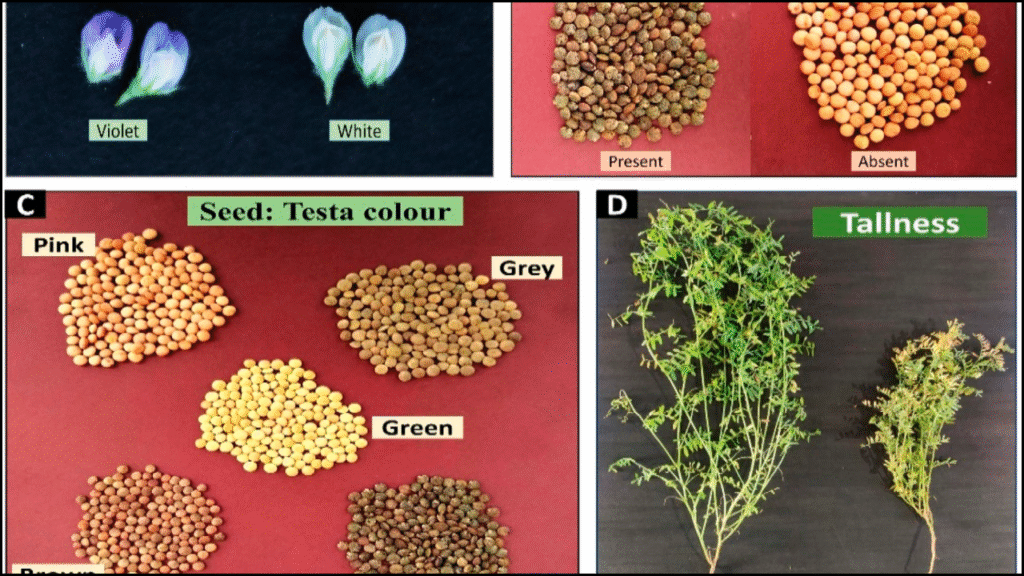
Lentil (Lens culinaris Medik.) stands as one of the most significant pulse crops globally, valued for its rich protein content, adaptability to various climates, and contribution to sustainable agriculture through nitrogen fixation. In recent years, the evaluation of genetic variability among lentil populations has gained importance to ensure crop improvement, climate resilience, and food security. Genetic variability determines the extent to which breeders can select superior genotypes for yield, quality, and stress resistance. Understanding this diversity provides a scientific basis for developing high-performing lentil cultivars suited to changing agricultural conditions.
Table of Contents
Importance Of Studying Genetic Variability
Genetic variability forms the foundation for plant breeding and crop improvement.
It allows breeders to select individuals with desirable traits such as high yield, early maturity, and disease resistance.
Evaluation of genetic diversity ensures long-term sustainability and adaptability of the crop.
Identification of unique genotypes supports germplasm conservation and utilization.
It aids in understanding evolutionary relationships among cultivated and wild lentil species.
Objectives Of Genetic Variability Evaluation In Lentils
Estimate the extent of variation among different genotypes.
Identify promising parental lines for hybridization.
Determine heritability and genetic advance for yield-related traits.
Assess genetic relationships using morphological and molecular markers.
Develop strategies for crop improvement and resilience.
Major Lentil-Producing Regions And Characteristics
Region
Countries / Areas
Climatic Conditions
Common Varieties
Key Traits
South Asia
India, Bangladesh, Nepal
Semi-arid to subtropical
PL-406, JL-3
Early maturity, heat tolerance
West Asia & North Africa
Turkey, Syria, Morocco
Mediterranean climate
Firat 87, Seyran 96
Drought resistance, high yield
North America
Canada, USA
Cool temperate
CDC Redberry, Eston
High seed quality, uniformity
Europe
Spain, France, Italy
Mild winters, moderate rainfall
Pardina, Castellana
High protein, adaptability
Australia
Southern and Western regions
Dry and warm
Nipper, PBA Jumbo
Resistance to Ascochyta blight
Parameters Used For Assessing Genetic Variability
Genetic variability in lentil populations is estimated using quantitative, qualitative, and molecular parameters that help determine heritable variation and potential for selection.
Parameter
Purpose
Description
Mean Performance
Evaluates general productivity
Average yield and growth parameters
Phenotypic & Genotypic Coefficients Of Variation (PCV & GCV)
Measures total and genetic variation
Indicates degree of variability in traits
Heritability (h²)
Estimates the proportion of genetic control
High heritability suggests strong selection potential
Genetic Advance (GA)
Predicts progress through selection
High GA indicates additive gene effects
Cluster Analysis
Groups genotypes based on similarities
Identifies diverse parental lines
Molecular Markers
DNA-based diversity estimation
SSR, RAPD, and ISSR are used for accurate genetic mapping
Morphological Traits Contributing To Variability
Plant Height: Affects biomass and lodging resistance.
Days To Flowering And Maturity: Determines adaptation to various climatic zones.
Pods Per Plant: Directly influences yield potential.
Seed Weight and Size: Important for market preference and genetic distinctiveness.
Biomass Production: Reflects overall plant vigor and productivity.
Growth Habit: Ranges from erect to semi-spreading forms, impacting yield stability.
Molecular Studies On Lentil Genetic Variability
Use of Simple Sequence Repeats (SSR) and Random Amplified Polymorphic DNA (RAPD) markers has revealed wide genetic variation among global lentil germplasm.
Inter-Simple Sequence Repeat (ISSR) markers show clear differentiation between wild species and cultivated varieties.
Single Nucleotide Polymorphism (SNP) markers enable fine-scale mapping of quantitative trait loci (QTLs) linked with yield and stress tolerance.
Genetic relationships often cluster lentil genotypes according to their geographical origin and morphological features.
Diversity Among Lentil Populations Based On Origin
Population Type
Genetic Diversity Level
Key Traits
Utilization In Breeding
Cultivated Varieties
Moderate
High yield, uniformity
Used for commercial cultivation
Landraces
High
Adaptation to local environments
Source of tolerance genes
Wild Relatives
Very High
Resistance to drought, salinity, and pests
Used for introgression of stress tolerance
Improved Hybrids
Moderate to High
Yield stability, disease resistance
Used in varietal replacement programs
Heritability And Genetic Advance Of Key Traits
Trait
Heritability (%)
Genetic Advance As % Of Mean
Implication For Selection
Plant Height
85
20
Controlled by additive genes, high response to selection
Days To Maturity
70
15
Moderately heritable, influenced by environment
Pods Per Plant
90
40
Strong genetic control, effective for yield improvement
Seed Weight
80
25
Easily selectable trait for quality breeding
Yield Per Plant
88
35
Indicates high potential for genetic improvement
Role Of Landraces And Wild Species
Landraces in regions like South Asia and Turkey hold unique adaptive traits developed over centuries.
Wild species such as Lens orientalis and Lens nigricans are reservoirs of genes for disease resistance, drought tolerance, and abiotic stress adaptation.
Hybridization between cultivated and wild species introduces new allelic combinations for crop resilience.
Conservation of landraces ensures long-term genetic stability and agro-biodiversity preservation.
Environmental Influence On Genetic Expression
Environmental factors significantly influence trait expression and variability.
Temperature fluctuations, soil fertility, and rainfall patterns modify phenotypic traits.
Genotypes exhibiting stable performance across locations are ideal for large-scale cultivation.
Multi-environment trials (METs) help identify genotypes with consistent yield and adaptability.
Applications Of Genetic Variability In Lentil Breeding
Selection of high-yielding genotypes with broad adaptability.
Development of stress-tolerant varieties through gene pyramiding.
Use of marker-assisted selection (MAS) for precise introgression of desirable traits.
Enhancement of seed quality, protein content, and disease resistance.
Integration of biotechnological tools for faster breeding cycles.
Challenges In Maintaining Genetic Variability
Challenge
Impact On Genetic Diversity
Suggested Solutions
Genetic Erosion
Loss of local germplasm due to monocropping
Promote in situ and ex situ conservation
Climate Change
Alters the adaptive capacity of genotypes
Develop climate-resilient breeding lines
Narrow Genetic Base
Limits the hybridization potential
Utilize wild relatives and landraces
Limited Marker Resources
Restricts molecular diversity studies
Expand genome sequencing initiatives
Poor Germplasm Exchange
Reduces global diversity integration
Strengthen international collaboration
Recent Advances In Lentil Genetic Research
Genome sequencing of lentil varieties has provided valuable insights into gene function and evolution.
CRISPR-Cas9 technology is being explored for targeted gene editing.
Genomic selection (GS) enhances breeding efficiency by predicting performance based on DNA data.
Bioinformatics tools support large-scale analysis of genetic datasets.
Phenotyping platforms using drones and sensors improve trait evaluation accuracy.
Economic And Agricultural Implications Of Genetic Diversity
Greater genetic variability leads to yield stability and reduced crop losses.
It supports market diversification by developing varieties for different regions and consumer preferences.
Disease-resistant and high-protein varieties increase farmer profitability and export potential.
Conservation of diverse lentil genotypes ensures food security and sustainable production systems.
Last Words
Genetic variability in lentil populations forms the cornerstone of breeding programs aimed at enhancing productivity, adaptability, and resilience. A broad genetic base enables the identification and selection of superior genotypes suited to diverse environments. Continued research integrating molecular tools, traditional breeding, and conservation strategies is essential to preserve this valuable diversity. Strengthening global cooperation and advancing genomic technologies will ensure the sustainable improvement of lentil varieties for future agricultural demands.
She is a creative and dedicated content writer who loves turning ideas into clear and engaging stories. She writes blog posts and articles that connect with readers. She ensures every piece of content is well-structured and easy to understand. Her writing helps our brand share useful information and build strong relationships with our audience.