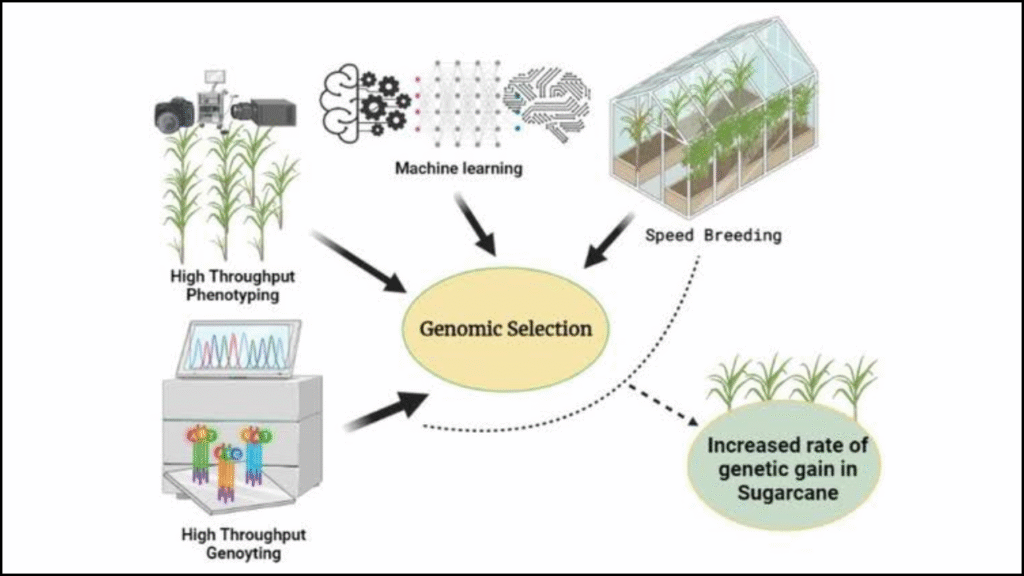
Agricultural innovation increasingly depends on modern genetic tools to accelerate crop improvement. Genomic selection (GS) represents one of the most transformative breeding technologies for field crops, allowing scientists to predict the performance of plants based on genetic information rather than waiting for field evaluations. This approach integrates genome-wide molecular data with advanced statistical models to estimate the genetic potential of breeding lines. The integration of genomic selection into field crop breeding programs enhances selection accuracy, shortens breeding cycles, and improves genetic gain, leading to more efficient development of high-yielding and stress-resilient crop varieties.
Table of Contents
Concept Of Genomic Selection
Genomic selection is a breeding method that uses DNA markers spread across the entire genome to predict the genetic value of individuals.
It relies on genomic estimated breeding values (GEBVs), calculated using a statistical model trained on both genotypic and phenotypic data.
Unlike traditional marker-assisted selection, which targets specific loci, GS captures the combined effect of all genes influencing complex traits.
The approach is particularly valuable for polygenic traits like yield, drought tolerance, and disease resistance.
Objectives Of Integrating Genomic Selection
Accelerate the rate of genetic improvement in field crops.
Enhance prediction accuracy for complex traits.
Reduce breeding cycle time and cost.
Identify superior genotypes early in the selection process.
Improve the adaptation of crops to changing climatic conditions.
Key Steps In A Genomic Selection Breeding Program
Step
Description
Outcome
1. Training Population Development
Select a representative set of genotypes with both phenotypic and genotypic data.
Establishes the foundation for model training.
2. Genotyping
Use high-density molecular markers such as SNPs across the genome.
Provides genome-wide genetic information.
3. Phenotyping
Collect accurate trait data under field or controlled conditions.
Ensures reliable model calibration.
4. Model Training
Apply statistical models (e.g., GBLUP, BayesA, BayesB, or Random Forest).
Develops predictive relationships between genotype and phenotype.
5. Prediction Of GEBVs
Use trained models to predict performance of untested genotypes.
Identifies superior lines without field testing.
6. Selection And Advancement
Choose high-GEBV individuals for crossing or release.
Improves breeding efficiency and genetic gain.
Advantages Of Genomic Selection Over Traditional Breeding
Higher Accuracy: Utilizes whole-genome information for complex traits.
Reduced Time: Eliminates the need for multi-year field testing before selection.
Cost Efficiency: Lowers long-term evaluation costs through early selection.
Faster Genetic Gain: Combines accuracy and shortened cycles for accelerated improvement.
Enhanced Diversity Utilization: Explores wider germplasm through genomic data.
Multi-Environment Prediction: Predicts performance under varying climatic conditions.
Application Of Genomic Selection In Major Field Crops
Crop
Traits Improved
Example Of Application
Wheat
Yield, disease resistance, drought tolerance
GS models predict performance in multi-environment trials.
Maize
Grain yield, stress resistance
Widely adopted for hybrid performance prediction.
Rice
Grain quality, nitrogen efficiency
Used for early selection in breeding pipelines.
Soybean
Protein content, maturity, and yield stability
GS improves the accuracy of multi-trait selection.
Barley
Malting quality, disease tolerance
Enhances genetic gain for quality and yield traits.
Sorghum
Biomass yield, heat tolerance
Used for climate-resilient variety development.
Statistical Models Used In Genomic Selection
Model Type
Description
Key Features
GBLUP (Genomic Best Linear Unbiased Prediction)
Assumes equal marker effects across the genome.
Simple and widely used for additive traits.
Bayesian Models (BayesA, BayesB, BayesC)
Allows variable marker effects with prior distributions.
Suitable for complex, polygenic traits.
Random Forest & Machine Learning Models
Uses non-linear relationships among markers.
Handles large datasets and interactions efficiently.
Reproducing Kernel Hilbert Space (RKHS)
Models non-additive effects and gene interactions.
Useful for heterosis and hybrid prediction.
Deep Learning Models
Integrates omics and environmental data.
Improves accuracy for multi-trait, multi-location data.
Integration Of GS Into Breeding Pipelines
Pre-Breeding Stage: Identify donor parents with desirable genomic profiles.
Early Generation Selection: Apply GS before field evaluation to filter inferior lines.
Hybrid Breeding: Predict general and specific combining abilities in parental lines.
Multi-Trait Selection: Optimize for yield, quality, and stress resistance simultaneously.
Speed Breeding Integration: Combine GS with rapid generation cycles for year-round improvement.
Economic And Environmental Benefits
Reduced Breeding Costs: Fewer field trials and labor expenses.
Efficient Resource Use: Minimizes land and water utilization in evaluation stages.
Sustainable Productivity: Rapid adaptation to climate change and biotic stresses.
Global Food Security: Faster release of improved crop varieties supports higher food production.
Challenges In Implementing Genomic Selection
Challenge
Impact
Possible Solution
High Genotyping Costs
Limits large-scale implementation.
Use cost-effective genotyping platforms and imputation methods.
Limited Training Populations
Reduces model accuracy.
Develop multi-environment and multi-year datasets.
Incomplete Phenotyping
Weakens prediction reliability.
Employ precision phenotyping tools and sensors.
Environmental Interactions (G×E)
Affects prediction stability.
Include environmental covariates in GS models.
Data Management Issues
Complex datasets require advanced infrastructure.
Use bioinformatics pipelines and data integration tools.
Recent Technological Advancements Enhancing GS
High-Throughput Phenotyping (HTP): Utilizes drones and sensors for accurate trait measurement.
Next-Generation Sequencing (NGS): Provides genome-wide marker coverage at reduced costs.
Multi-Omics Integration: Combines genomics, transcriptomics, and metabolomics for better prediction.
Cloud-Based Breeding Platforms: Enable global data sharing and collaboration.
Artificial Intelligence: Improves predictive modeling through machine learning algorithms.
Future Prospects Of Genomic Selection In Crop Breeding
Development of pan-genome-based GS models for higher accuracy.
Integration of epigenetic data to understand heritable non-DNA-based variation.
Expansion of multi-trait and multi-environment genomic prediction frameworks.
Adoption of open-source breeding databases for knowledge exchange.
Use of genome editing tools (CRISPR) with GS for targeted improvement.
Case Studies Of Successful Integration
Crop
Region
Outcome
Wheat (CIMMYT)
Global
40% reduction in breeding cycle duration.
Maize (Corn Belt, USA)
USA
Improved hybrid prediction accuracy by 30%.
Rice (IRRI)
Asia
Accelerated release of high-yielding drought-tolerant varieties.
Soybean (Brazil)
South America
Enhanced yield stability and early maturity selection.
Best Practices For Effective Integration
Maintain diverse and representative training populations.
Continuously update models with new phenotypic data.
Combine genomic and environmental information for better predictions.
Encourage interdisciplinary collaboration among breeders, geneticists, and data scientists.
Ensure capacity building and training in computational genomics.
Key Takeaways
Genomic selection stands as a revolutionary approach in modern crop breeding, offering unprecedented opportunities to accelerate genetic gains in field crops. By leveraging genome-wide information, GS enables breeders to make accurate predictions, optimize resource use, and release improved varieties faster than traditional methods. The integration of genomic selection with advanced technologies such as high-throughput phenotyping, artificial intelligence, and genome editing will redefine future breeding programs. A well-structured and data-driven genomic selection framework ensures that global agriculture remains resilient, productive, and sustainable in the face of evolving environmental and food security challenges.
She is a creative and dedicated content writer who loves turning ideas into clear and engaging stories. She writes blog posts and articles that connect with readers. She ensures every piece of content is well-structured and easy to understand. Her writing helps our brand share useful information and build strong relationships with our audience.