Tomato (Solanum lycopersicum L.) is one of the most widely cultivated vegetable crops in the world, valued for its nutritional, economic, and industrial importance. However, its productivity is frequently threatened by Fusarium wilt, a disease caused by Fusarium oxysporum f. sp. lycopersici (FOL). This soil-borne pathogen invades plant roots, leading to severe yield losses, especially in warm and humid regions. Mutation breeding has emerged as a powerful approach to developing tomato varieties resistant to Fusarium wilt by inducing genetic variations that cannot be easily achieved through conventional breeding. The following sections explore how mutation breeding contributes to enhancing tomato resistance, its methodology, achievements, and prospects.
Table of Contents
Importance Of Fusarium Resistance In Tomato
- Fusarium wilt causes extensive yield losses, sometimes up to 60–80% under severe infestations.
- The pathogen persists in soil for several years, making chemical control ineffective.
- Resistant varieties offer an eco-friendly and cost-effective solution.
- Development of resistant cultivars ensures long-term sustainability and reduced pesticide use.
- Genetic resistance helps maintain fruit quality and productivity even in infested fields.
Overview Of Mutation Breeding
Mutation breeding involves the artificial induction of genetic changes using physical or chemical mutagens to create variability in plant traits. These mutations may result in beneficial alleles conferring disease resistance, improved yield, or stress tolerance.
Common Mutagenic Agents Used In Tomato Breeding
| Type Of Mutagen | Examples | Mode Of Action | Effect On Tomato |
|---|---|---|---|
| Physical Mutagens | Gamma rays, X-rays, UV light | Induce DNA strand breaks and chromosomal rearrangements | Generate genetic variation and new resistance genes |
| Chemical Mutagens | EMS (Ethyl Methane Sulfonate), Sodium Azide | Alter base pairing, causing point mutations | Produce specific gene modifications for resistance |
| Biological Mutagens | Transposons, T-DNA insertions | Cause gene insertions or disruptions | Used for identifying resistance pathways |
Mechanism Of Fusarium Infection In Tomato
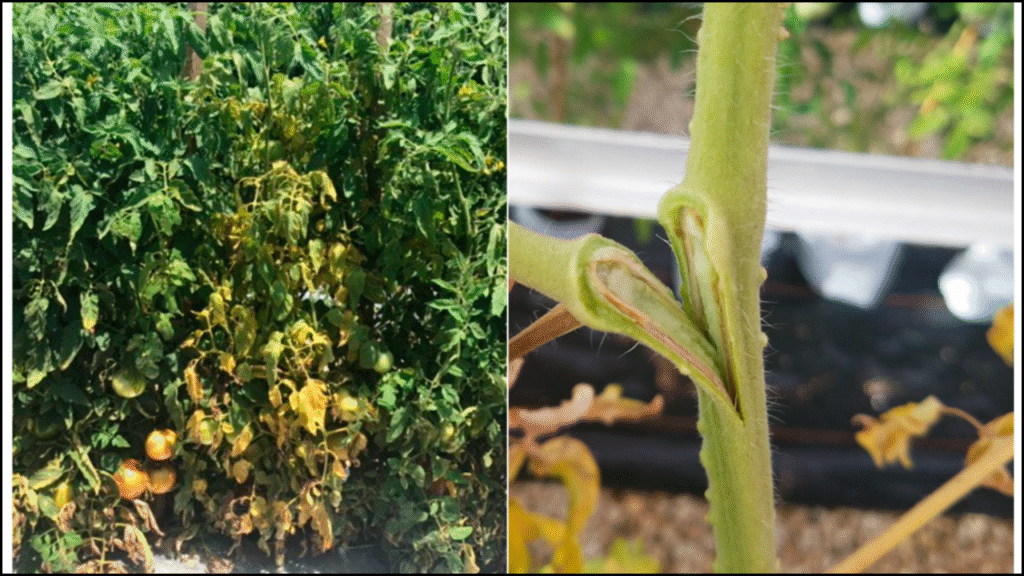
- The pathogen infects roots and colonizes xylem vessels.
- Blockage of vascular tissues causes wilting, chlorosis, and stunted growth.
- Different races of FOL (Race 1, Race 2, and Race 3) infect tomato genotypes differently.
- Resistant plants produce pathogenesis-related proteins, lignin, and phytoalexins to restrict pathogen growth.
Role Of Mutation Breeding In Enhancing Fusarium Resistance
Mutation breeding introduces novel alleles that improve host resistance mechanisms. Resistant mutants often show:
- Thicker cell walls and enhanced lignin deposition impede fungal invasion.
- Elevated activity of defense enzymes such as peroxidase and polyphenol oxidase.
- Overexpression of resistance (R) genes that recognize Fusarium effector proteins.
- Improved root architecture that minimizes pathogen entry.
Procedure For Developing Fusarium-Resistant Tomato Mutants
| Stage | Process Description | Expected Outcome |
|---|---|---|
| 1. Selection Of Parent Material | Choose susceptible but high-yielding cultivars for mutation treatment. | Genetic base for improvement. |
| 2. Mutagenic Treatment | Expose seeds or tissues to gamma rays or EMS. | Induction of random mutations. |
| 3. Raising M₁ Generation | Grow treated seeds and allow natural segregation. | Observe basic viability and variation. |
| 4. Screening In M₂ Generation | Test plants for Fusarium resistance under controlled conditions. | Identify resistant individuals. |
| 5. Confirmation And Stability Testing | Re-test selected mutants across environments. | Confirm stable resistance traits. |
| 6. Variety Release And Multiplication | Promote superior mutants through trials and seed multiplication. | Distribution to farmers. |
Examples Of Successful Mutation Breeding For Fusarium Resistance In Tomato
| Variety / Mutant Line | Mutagen Used | Resistance Achieved Against | Key Traits Improved |
|---|---|---|---|
| ‘Roma Muttant FWR-1’ | Gamma rays | FOL Race 1 | Enhanced resistance and yield stability |
| ‘Pusa Rohini (Mutant)’ | EMS | FOL Race 2 | Strong vascular defense and thicker roots |
| ‘Mutant Line TM-7’ | Sodium Azide | FOL Race 3 | Improved antioxidant enzyme activity |
| ‘Arka Mutant-1’ | Gamma rays | Multiple Fusarium races | Broader resistance spectrum and high fruit firmness |
Physiological And Biochemical Changes In Resistant Mutants
- Increased phenolic content strengthens cell walls against infection.
- Enhanced antioxidant enzyme activity mitigates oxidative stress caused by Fusarium invasion.
- Elevated pathogenesis-related proteins (PRs) boost systemic acquired resistance (SAR).
- Reduced vascular colonization limits the spread of the pathogen within the plant.
- Improved nutrient balance promotes plant vigor and recovery post-infection.
Advantages Of Mutation Breeding Over Conventional Methods
- Produces new genetic variations without hybridization barriers.
- Requires less time and cost compared to transgenic approaches.
- Can improve multiple traits simultaneously, such as yield and resistance.
- Generates non-transgenic mutants, acceptable for commercial cultivation.
- Useful for reviving old cultivars with added resistance traits.
Challenges In Mutation Breeding For Fusarium Resistance
| Challenge | Impact On Breeding Process | Suggested Solution |
|---|---|---|
| Random Nature Of Mutations | May produce undesirable traits. | Use marker-assisted selection for precise screening. |
| Low Frequency Of Useful Mutations | Requires large population screening. | Combine mutagenesis with genomic selection. |
| Environmental Influence | Resistance expression may vary by environment. | Conduct multi-location trials for confirmation. |
| Identification Of Mutant Genes | Complex genetic basis of resistance. | Apply genomic and transcriptomic analyses. |
| Limited Awareness Among Growers | Slow adoption of mutant lines. | Strengthen extension programs for dissemination. |
Molecular Tools Supporting Mutation Breeding
- Marker-Assisted Selection (MAS): Helps identify resistant mutants carrying I and I-2 resistance genes.
- Quantitative Trait Loci (QTL) Mapping: Locates genomic regions contributing to resistance.
- Genome Sequencing: Detects mutation sites and their effects on gene function.
- Transcriptomic Studies: Reveal gene expression changes after Fusarium infection.
- CRISPR-Cas9 Integration: Used to confirm mutation function or enhance resistance genes.
Integration Of Mutation Breeding With Conventional And Modern Approaches
- Mutation breeding complements hybridization programs by introducing new alleles.
- Mutant lines can serve as donor parents for Fusarium resistance in breeding pipelines.
- Combined with in vitro culture techniques, mutagenesis allows rapid propagation of resistant lines.
- Integration with molecular breeding improves selection precision and reduces breeding time.
Impact Of Mutation Breeding On the Tomato Industry
- Enhanced availability of Fusarium-resistant varieties has significantly reduced yield losses.
- Decreased dependence on chemical fungicides contributes to environmental protection.
- Farmers benefit from higher yields and reduced production costs.
- Breeding programs gain access to diverse genetic resources for further improvement.
- The export potential of disease-free tomato produce has increased globally.
Recent Research Highlights
- Development of mutants with resistance to multiple Fusarium races in Asia and Europe.
- Identification of novel alleles in resistant mutants using whole-genome resequencing.
- Application of gamma irradiation combined with molecular screening for efficient selection.
- Use of omics-based approaches (genomics, proteomics, metabolomics) to understand defense pathways.
Future Prospects Of Mutation Breeding In Tomato Resistance
- Adoption of speed mutation breeding to shorten development time.
- Integration with machine learning models for predictive selection of mutants.
- Development of multi-disease-resistant cultivars combining Fusarium and Verticillium resistance.
- Expansion of international mutation databases for germplasm sharing.
- Strengthening of public-private collaborations for large-scale mutant screening.
Future Implications
Mutation breeding has proven to be a valuable tool for improving tomato resistance to Fusarium wilt by generating beneficial genetic variability and developing stable, resistant cultivars. Through the combination of physical and chemical mutagens, breeders have successfully identified new alleles conferring strong and durable resistance. Integration of molecular markers and genomic tools has enhanced selection efficiency, making mutation breeding a precise and reliable approach. The continued application of this technique will ensure sustainable tomato production, reduced chemical dependency, and greater resilience of tomato crops against emerging Fusarium races in the future.